Asset safety
Section titled “Asset safety”Inscribe will not pay a fee with an output that holds your assets.
Why this matters
Section titled “Why this matters”Bitcoin spends an output whole. An output holding an inscription, a Rune balance or a token balance looks the same as ordinary bitcoin to software that only checks the amount. If a tool picks that output to cover a network fee, the asset goes with it, and there is no way back.
This is not a rare edge case. Trust Wallet dropped inscription support in March 2026 and warned its users that bitcoin sent from an address holding inscribed outputs could spend those outputs by accident.
What Inscribe does
Section titled “What Inscribe does”Every Inscribe flow that chooses funding outputs for you asks the Universe asset index what each output holds before it picks anything.
- An output the index reports as holding an inscription, a Rune balance or a token balance is never used to pay a fee.
- An output the index confirms is plain bitcoin is used first.
- An output the index cannot classify is used only after the confirmed ones.
This covers ChainBloom, Drop transfers, OP_DROP funding and settlement, OP_DROP ownership proofs, Patina commits, and inscription transfers.
Nothing here stops you from spending an asset-bearing output on purpose. It stops Inscribe from doing it on your behalf.
When funding is short
Section titled “When funding is short”If Inscribe holds outputs back and the remaining balance cannot cover the action, it tells you how many outputs were held back, how many sats they hold, and why. You are never told to add bitcoin you already have.
To free the balance, send plain bitcoin to the address, or lower the fee rate.
Choosing outputs yourself
Section titled “Choosing outputs yourself”Two surfaces let you pick outputs directly and show the asset report for each one before you sign:
- Split UTXO shows a full asset preflight report per output.
- Custom transaction lists your outputs with their asset classification.
What Inscribe does not claim
Section titled “What Inscribe does not claim”Inscribe reports what the Universe asset index knows. Where the index has no answer for an output, Inscribe says so rather than calling the output safe. Coverage improves as the index does, and the flows above use confirmed outputs ahead of unconfirmed ones automatically.
When you send bitcoin through your wallet’s own send screen, your wallet chooses the outputs, not Inscribe. Inscribe shows a warning where it can see a risk, but it cannot change that selection.
The warning before a wallet payment
Section titled “The warning before a wallet payment”Immediately before your wallet opens, Inscribe scans the address the payment will come from and lists any outputs that hold assets:
The address you are paying from holds assets. Your wallet chooses which outputs pay for this. If it spends one of these, the asset it carries goes with it, and Inscribe cannot bring it back. Pay from an address that holds only bitcoin, or pick the inputs yourself in your wallet before you approve.
It lists the outpoint and what each output carries. It does not stop you. The wallet owns the selection, you may have a good reason to pay from that address, and an app that blocked you would be wrong more often than it was right.
Only outputs the index positively identified appear. An output with an incomplete, stale, or out-of-network scan is not listed, and is also never picked automatically by the flows above.
A note on addresses
Section titled “A note on addresses”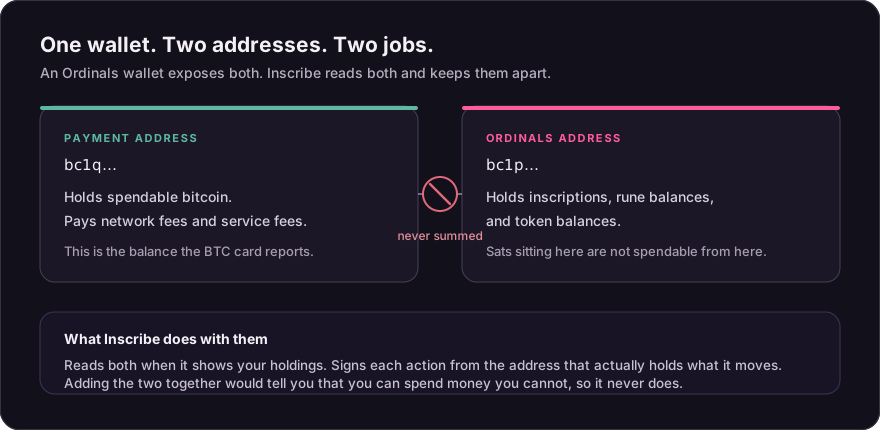
An Ordinals wallet keeps two addresses: a payment address for spendable bitcoin and a Taproot Ordinals address for inscriptions, Runes and token balances. Inscribe reads both when it shows your holdings, and a transfer is signed from the address that actually holds the balance you are sending.
The bitcoin balance card still reports the payment address on its own. Sats sitting at an Ordinals address are not spendable from there, and adding them together would tell you that you can spend money you cannot.